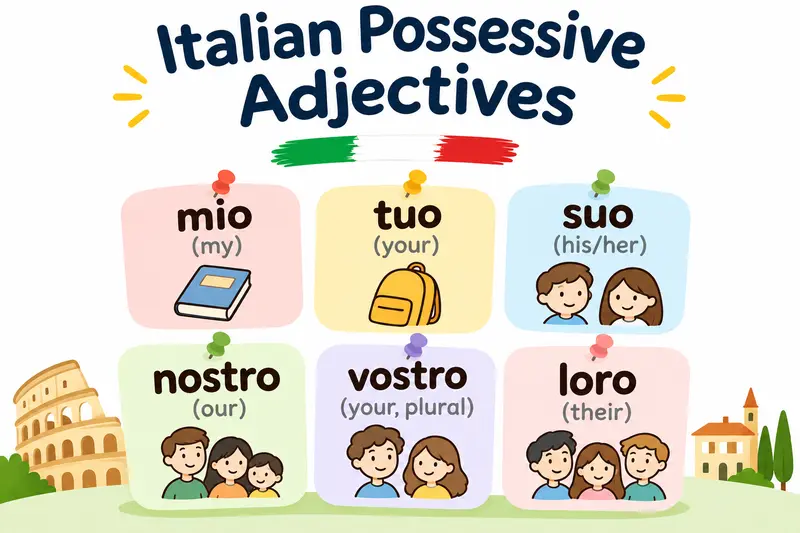
How do you say my, your, his, her, our, or their in Italian?
The answer involves Italian possessive adjectives, including mio, tuo, suo, nostro, vostro, and loro.
These small words are essential for everyday conversations. You’ll use them when introducing family members, talking about friends, describing belongings, or explaining relationships.
However, Italian possessives work differently from their English equivalents.
For example, English uses my in both “my book” and “my house.” Italian changes the possessive depending on the gender and number of the noun:
- il mio libro — my book
- la mia casa — my house
- i miei libri — my books
- le mie case — my houses
Italian also commonly places a definite article before the possessive, although there are important exceptions.
In this guide, you’ll learn how Italian possessive adjectives work, when to use articles, and how to avoid common mistakes.
Table of Contents
Open Table of Contents
- What are Italian possessive adjectives?
- Italian possessive adjectives chart
- Mio, mia, miei, mie: How agreement works
- Tuo, tua, tuoi, tue: Saying “your” in Italian
- Suo, sua, suoi, sue: His, her, and its
- Nostro and vostro: Our and your
- Loro: How to say “their” in Italian
- When do Italian possessive adjectives need an article?
- The family-member exception: Mio padre, mia madre
- Possessives after essere: Questo libro è mio
- Using possessives with indefinite articles
- Everyday Italian sentences with possessive adjectives
- Real-life conversations with Italian possessives
- Common mistakes with Italian possessive adjectives
- Mistake 1: Forgetting gender agreement
- Mistake 2: Forgetting number agreement
- Mistake 3: Choosing suo based on the owner’s gender
- Mistake 4: Adding articles to simple singular family terms
- Mistake 5: Forgetting the article with loro
- Mistake 6: Changing loro for gender
- Mistake 7: Confusing tuo and vostro
- Practice exercises: Italian possessive adjectives
- Exercise answers
- How to memorize Italian possessive adjectives
- Frequently asked questions
- What are the possessive adjectives in Italian?
- What is the difference between mio and mia?
- What is the difference between mio and miei?
- Does suo mean his or her?
- Why do Italians say mio padre instead of il mio padre?
- Why is it i miei amici but mio fratello?
- Does loro change for masculine and feminine nouns?
- What is the difference between tuo and vostro?
- Can Italian possessives appear without articles?
- Final thoughts
What are Italian possessive adjectives?
Possessive adjectives indicate ownership, belonging, or a relationship between people and things.
In English, the main possessive adjectives are:
- my
- your
- his
- her
- its
- our
- their
Italian uses several corresponding forms:
| English | Italian |
|---|---|
| My | mio, mia, miei, mie |
| Your (informal singular) | tuo, tua, tuoi, tue |
| His / Her / Its | suo, sua, suoi, sue |
| Our | nostro, nostra, nostri, nostre |
| Your (plural) | vostro, vostra, vostri, vostre |
| Their | loro |
The most important difference is that Italian possessive adjectives usually agree with the noun being possessed, not with the person who owns it.
For example:
Marco ha una macchina. La sua macchina è rossa.
Marco has a car. His car is red.
Giulia ha una macchina. La sua macchina è rossa.
Giulia has a car. Her car is red.
Notice that sua stays the same in both sentences.
That’s because macchina is a feminine singular noun.
The owner’s gender does not determine the possessive ending.
Italian possessive adjectives chart
The following chart shows the main possessive adjective forms.
| Owner | Masculine singular | Feminine singular | Masculine plural | Feminine plural |
|---|---|---|---|---|
| io (my) | mio | mia | miei | mie |
| tu (your) | tuo | tua | tuoi | tue |
| lui / lei (his / her) | suo | sua | suoi | sue |
| noi (our) | nostro | nostra | nostri | nostre |
| voi (your, plural) | vostro | vostra | vostri | vostre |
| loro (their) | loro | loro | loro | loro |
The first five groups change according to the noun’s gender and number.
Loro is different: it remains unchanged.
Compare:
- il loro libro — their book
- la loro casa — their house
- i loro libri — their books
- le loro case — their houses
Only the article and noun change.
The possessive loro stays the same.
Mio, mia, miei, mie: How agreement works
Let’s begin with mio, meaning “my.”
Italian nouns have grammatical gender and number.
A possessive adjective must normally match both.
Masculine singular: mio
Use mio with masculine singular nouns.
Il mio libro — My book
Additional examples:
- il mio telefono — my phone
- il mio amico — my male friend
- il mio lavoro — my job
Feminine singular: mia
Use mia with feminine singular nouns.
La mia casa — My house
Additional examples:
- la mia macchina — my car
- la mia amica — my female friend
- la mia scuola — my school
Notice that la mia amica keeps the full article la.
Unlike ordinary combinations such as l’amica, an article before a possessive adjective is generally not shortened.
Masculine plural: miei
Use miei with masculine plural nouns.
I miei libri — My books
Additional examples:
- i miei amici — my male friends or mixed-gender group of friends
- i miei fratelli — my brothers
- i miei documenti — my documents
Feminine plural: mie
Use mie with feminine plural nouns.
Le mie amiche — My female friends
Additional examples:
- le mie scarpe — my shoes
- le mie sorelle — my sisters
- le mie chiavi — my keys
Quick agreement rule
Remember these four patterns:
| Noun type | Possessive | Example |
|---|---|---|
| Masculine singular | mio | il mio libro |
| Feminine singular | mia | la mia casa |
| Masculine plural | miei | i miei libri |
| Feminine plural | mie | le mie case |
The same general pattern applies to tuo, suo, nostro, and vostro.
If you need a refresher on masculine and feminine nouns, see our guide to Italian articles.
Tuo, tua, tuoi, tue: Saying “your” in Italian
Use tuo and its related forms when speaking informally to one person.
For example:
Il tuo nome — Your name
Other examples:
- la tua famiglia — your family
- i tuoi amici — your friends
- le tue scarpe — your shoes
Here are some everyday sentences.
Qual è il tuo nome?
What is your name?
Dov’è la tua macchina?
Where is your car?
Questi sono i tuoi libri?
Are these your books?
Le tue chiavi sono sul tavolo.
Your keys are on the table.
Notice that the possessive changes with the noun.
It does not change according to the gender of the person being addressed.
Tuo vs. vostro
Italian distinguishes between informal singular “your” and plural “your.”
Use tuo when speaking informally to one person.
Use vostro when addressing multiple people.
Compare:
Questa è la tua casa?
Is this your house? — Speaking to one person.
Questa è la vostra casa?
Is this your house? — Speaking to multiple people.
The noun casa is feminine singular, so both possessives take the feminine singular form.
Suo, sua, suoi, sue: His, her, and its
One of the most important differences between English and Italian is the use of suo.
English distinguishes between:
- his
- her
- its
Italian commonly uses the same possessive family for all three meanings.
For example:
Il suo libro
This can mean:
- his book
- her book
- its book
The correct interpretation depends on context.
Example: His book
Marco cerca il suo libro.
Marco is looking for his book.
Example: Her book
Giulia cerca il suo libro.
Giulia is looking for her book.
The possessive remains suo because libro is masculine singular.
Example: His or her house
La sua casa
This can mean either “his house” or “her house.”
Again, the feminine singular form sua agrees with casa.
How to avoid confusion
If the owner is unclear, Italian speakers can identify the person more explicitly.
For example:
Questo è il libro di Marco.
This is Marco’s book.
Questa è la macchina di Giulia.
This is Giulia’s car.
Using di + person’s name is a simple way to clarify ownership.
What about formal “your”?
Italian also uses Suo and related forms for formal address.
For example:
Qual è il Suo nome?
What is your name? — Formal.
Questa è la Sua valigia?
Is this your suitcase? — Formal.
Capitalizing the formal possessive is a traditional courtesy convention, especially in formal correspondence. Lowercase forms are also common in modern Italian.
In spoken Italian, context and the formal form of address help distinguish formal “your” from “his” or “her.”
Nostro and vostro: Our and your
The possessive nostro means “our.”
Like mio, it changes according to the noun.
| Form | Example | English |
|---|---|---|
| nostro | il nostro amico | our male friend |
| nostra | la nostra casa | our house |
| nostri | i nostri amici | our friends |
| nostre | le nostre amiche | our female friends |
For example:
La nostra famiglia — Our family
La nostra casa è grande.
Our house is big.
I nostri amici vivono a Roma.
Our friends live in Rome.
The possessive vostro follows the same pattern.
| Form | Example | English |
|---|---|---|
| vostro | il vostro libro | your book |
| vostra | la vostra casa | your house |
| vostri | i vostri libri | your books |
| vostre | le vostre case | your houses |
Remember that vostro refers to more than one person being addressed.
Loro: How to say “their” in Italian
The possessive loro means “their.”
Unlike the other possessives, loro does not change for gender or number.
For example:
La loro casa — Their house
Additional examples:
- il loro cane — their dog
- i loro figli — their children
- le loro macchine — their cars
Here are some complete sentences.
I loro genitori vivono in Italia.
Their parents live in Italy.
La loro macchina è nuova.
Their car is new.
I loro amici sono simpatici.
Their friends are nice.
The possessive loro remains unchanged in every example.
When do Italian possessive adjectives need an article?
In English, we normally say:
- my book
- your house
- our friends
We don’t say “the my book.”
Italian works differently.
In many ordinary noun phrases, Italian uses a definite article before the possessive adjective.
For example:
| English | Italian |
|---|---|
| My book | il mio libro |
| Your house | la tua casa |
| His car | la sua macchina |
| Our friends | i nostri amici |
| Their children | i loro figli |
The basic structure is:
Definite article + possessive adjective + noun
However, the correct article depends on the noun, not simply on the possessive.
Choosing the correct article
Compare:
Il mio libro
My book.
Lo zaino mio
My backpack.
The second expression is grammatical but has a more marked or emphatic word order.
In ordinary speech, you would usually say:
Il mio zaino
My backpack.
Why il mio zaino rather than lo mio zaino?
Because the article comes immediately before mio, not directly before zaino.
Similarly:
I miei studenti
My students.
Gli studenti
The students.
The possessive changes which word immediately follows the article.
This is an important detail when learning Italian articles.
Articles are not always required
Some common situations omit the definite article.
These include:
- certain singular family-member expressions
- possessives used after essere
- some fixed expressions
- possessives used with indefinite articles
Let’s examine the most important exception first.
The family-member exception: Mio padre, mia madre
Italian usually omits the definite article before a possessive adjective when referring to a singular, unmodified family-member noun.
For example:
Mio padre — My father
Mia madre — My mother
Other examples include:
- mio fratello — my brother
- mia sorella — my sister
- tuo padre — your father
- sua madre — his or her mother
- nostro figlio — our son
- vostra figlia — your daughter
Notice that these expressions do not normally use il or la.
When the family-member noun is plural
The article generally returns when the noun is plural.
For example:
I miei genitori
My parents.
Le mie sorelle
My sisters.
I tuoi fratelli
Your brothers.
I nostri figli
Our children.
Compare:
| Singular | Plural |
|---|---|
| mio fratello | i miei fratelli |
| mia sorella | le mie sorelle |
| tuo figlio | i tuoi figli |
| nostra figlia | le nostre figlie |
When the family member is described
The article is generally used when an adjective modifies the family-member noun.
For example:
Il mio caro padre
My dear father.
La mia sorella maggiore
My older sister.
Il tuo fratello più piccolo
Your younger brother.
The extra description changes the usual article pattern.
When using loro
The possessive loro normally requires the article even with singular family-member nouns.
For example:
Il loro padre
Their father.
La loro madre
Their mother.
Il loro fratello
Their brother.
This is an important exception to the family-member exception.
What about mamma and papà?
With familiar family terms such as mamma and papà, both forms with and without the article occur in Italian.
For example:
Mia mamma
My mom.
La mia mamma
My mom.
Mio papà
My dad.
Il mio papà
My dad.
Usage can vary according to context, region, and style.
For beginners, the most useful general rule is:
Omit the article with simple singular family-member nouns, but remember the exceptions.
Possessives after essere: Questo libro è mio
Italian possessives can also appear without a following noun.
This happens when ownership is already clear from the conversation.
For example:
Questo libro è mio.
This book is mine.
Compare:
Questo è il mio libro.
This is my book.
Questo libro è mio.
This book is mine.
Both sentences are correct, but their structures are different.
In the second sentence, mio appears after essere and does not require an article.
Other examples:
Questa macchina è tua.
This car is yours.
Questi libri sono nostri.
These books are ours.
Queste chiavi sono sue.
These keys are his or hers.
Quella casa è loro.
That house is theirs.
Notice that the possessive still agrees with the thing being possessed.
Possessive adjectives vs. possessive pronouns
In traditional grammar, possessives such as mio and tuo may function as adjectives or pronouns depending on how they are used.
Compare:
Il mio telefono è nuovo.
My phone is new.
Here, mio modifies the noun telefono.
Il mio è nuovo.
Mine is new.
Here, il mio replaces a noun already understood from context.
Both uses follow the same gender and number agreement patterns.
Using possessives with indefinite articles
Italian possessives can also appear with indefinite articles.
For example:
Un mio amico
A friend of mine.
Una mia amica
A female friend of mine.
Un nostro collega
A colleague of ours.
These expressions are especially useful when introducing someone.
Compare:
Il mio amico Marco vive a Milano.
My friend Marco lives in Milan.
Un mio amico vive a Milano.
A friend of mine lives in Milan.
The second sentence introduces one friend without identifying which friend.
You can use the same structure with other possessives:
Un suo amico
A friend of his or hers.
Una loro collega
A colleague of theirs.
This is a natural way to express “one of someone’s friends” or “a friend of mine.”
Everyday Italian sentences with possessive adjectives
Let’s put these grammar rules into practical situations.
Talking about family
Mio padre lavora a Roma.
My father works in Rome.
Mia sorella studia italiano.
My sister studies Italian.
I miei genitori vivono a Firenze.
My parents live in Florence.
La nostra famiglia è numerosa.
Our family is large.
Talking about belongings
Dov’è il mio telefono?
Where is my phone?
La tua borsa è sul tavolo.
Your bag is on the table.
Queste sono le mie chiavi.
These are my keys.
Il suo computer è nuovo.
His or her computer is new.
Talking about friends
Il mio migliore amico si chiama Luca.
My best friend’s name is Luca.
La tua amica parla inglese?
Does your friend speak English?
I nostri amici arrivano domani.
Our friends are arriving tomorrow.
Le loro amiche vivono a Napoli.
Their female friends live in Naples.
Talking about school and work
Il mio insegnante è italiano.
My teacher is Italian.
La nostra scuola è vicino al centro.
Our school is near the city center.
I vostri colleghi sono molto gentili.
Your colleagues are very kind.
Il loro ufficio è al secondo piano.
Their office is on the second floor.
These examples combine possessive adjectives with common present-tense verbs.
If you’re still learning how Italian verbs change, see our guide to the Italian present tense.
Real-life conversations with Italian possessives
Here are three short conversations showing how possessive adjectives work in everyday Italian.
Conversation 1: Introducing family members
A: Chi è quella ragazza?
Who is that girl?
B: È mia sorella.
She’s my sister.
A: Come si chiama?
What’s her name?
B: Si chiama Giulia.
Her name is Giulia.
Notice that mia sorella does not require an article.
Conversation 2: Looking for a phone
A: Dov’è il mio telefono?
Where is my phone?
B: È sul tavolo.
It’s on the table.
A: Questo telefono è tuo?
Is this phone yours?
B: No, è di Marco.
No, it’s Marco’s.
Here, mio appears before the noun, while tuo appears after essere.
Conversation 3: Talking about friends
A: I tuoi amici vengono alla festa?
Are your friends coming to the party?
B: Sì, vengono anche i loro fratelli.
Yes, their brothers are coming too.
A: Perfetto! Anche i miei amici vengono.
Perfect! My friends are coming too.
Notice the difference between:
- i tuoi amici — your friends
- i loro fratelli — their brothers
- i miei amici — my friends
Common mistakes with Italian possessive adjectives
Let’s review some errors that English speakers frequently make.
Mistake 1: Forgetting gender agreement
Incorrect: il mia libro
Correct: il mio libro
The noun libro is masculine singular, so the possessive must be mio.
Mistake 2: Forgetting number agreement
Incorrect: i mio libri
Correct: i miei libri
The noun libri is masculine plural.
Therefore, use miei.
Mistake 3: Choosing suo based on the owner’s gender
Incorrect: Giulia cerca il sua libro.
Correct: Giulia cerca il suo libro.
The possessive agrees with libro, not with Giulia.
Mistake 4: Adding articles to simple singular family terms
Less natural in standard Italian: il mio padre
Standard: mio padre
Simple singular family-member expressions normally omit the article.
Mistake 5: Forgetting the article with loro
Incorrect: loro padre
Correct: il loro padre
Unlike mio, tuo, and similar possessives, loro normally keeps the article with singular family-member nouns.
Mistake 6: Changing loro for gender
Incorrect: la lora casa
Correct: la loro casa
The possessive loro never changes form.
Mistake 7: Confusing tuo and vostro
Tuo refers to one person being addressed informally.
Vostro refers to multiple people.
Compare:
È il tuo libro?
Is it your book? — One person.
È il vostro libro?
Is it your book? — Multiple people.
Practice exercises: Italian possessive adjectives
Now it’s time to test what you’ve learned.
Exercise 1: Choose the correct possessive
Complete each sentence using the appropriate form of mio.
- Il ______ libro è interessante.
- La ______ macchina è rossa.
- I ______ amici vivono a Roma.
- Le ______ scarpe sono nuove.
- La ______ famiglia è italiana.
Exercise 2: Choose the correct answer
1. How do you say “my sister”?
A. la mia sorella
B. mia sorella
C. mio sorella
2. How do you say “their house”?
A. la loro casa
B. la lora casa
C. loro casa
3. How do you say “our friends”?
A. i nostro amici
B. i nostri amici
C. le nostri amici
4. Which sentence means “This car is mine”?
A. Questa macchina è mia.
B. Questa macchina è mio.
C. Questa macchina è miei.
5. How do you say “his book” or “her book”?
A. la sua libro
B. il suo libro
C. il suoi libro
Exercise 3: Translate into Italian
Translate these expressions.
- Your house (informal singular)
- My parents
- Our family
- Their children
- Her car
- My female friends
- Your books (addressing multiple people)
- A friend of mine (male friend)
Exercise 4: Correct the mistakes
Find and correct the possessive errors.
- Il mia telefono è nuovo.
- La tuo casa è grande.
- I mio amici sono italiani.
- Loro madre lavora a Milano.
- Queste chiavi sono mio.
Exercise answers
Exercise 1
- mio
- mia
- miei
- mie
- mia
Exercise 2
- B — mia sorella
- A — la loro casa
- B — i nostri amici
- A — Questa macchina è mia.
- B — il suo libro
Exercise 3
- la tua casa
- i miei genitori
- la nostra famiglia
- i loro figli
- la sua macchina
- le mie amiche
- i vostri libri
- un mio amico
Exercise 4
- Il mio telefono è nuovo.
- La tua casa è grande.
- I miei amici sono italiani.
- La loro madre lavora a Milano.
- Queste chiavi sono mie.
How to memorize Italian possessive adjectives
The easiest way to learn Italian possessives is to practice them with familiar nouns.
Start with four nouns:
- libro — book (masculine singular)
- casa — house (feminine singular)
- libri — books (masculine plural)
- case — houses (feminine plural)
Then practice changing the possessive.
For example:
| My | Your | Our |
|---|---|---|
| il mio libro | il tuo libro | il nostro libro |
| la mia casa | la tua casa | la nostra casa |
| i miei libri | i tuoi libri | i nostri libri |
| le mie case | le tue case | le nostre case |
Once you’re comfortable with these patterns, replace the nouns with words from your daily life.
For example:
Il mio telefono
My phone.
La mia famiglia
My family.
I miei amici
My friends.
Le mie chiavi
My keys.
Finally, practice using possessives in complete sentences.
Il mio telefono è nuovo.
My phone is new.
La mia famiglia vive in Italia.
My family lives in Italy.
I miei amici parlano italiano.
My friends speak Italian.
Short, repeated practice is more useful than trying to memorize every form at once.
Frequently asked questions
What are the possessive adjectives in Italian?
The main Italian possessive adjectives are mio, tuo, suo, nostro, vostro, and loro, along with their gender and number variations.
They correspond to English words such as my, your, his, her, our, and their.
What is the difference between mio and mia?
Mio is masculine singular, while mia is feminine singular.
For example:
Il mio libro — My book
La mia casa — My house
The form depends on the noun being possessed.
What is the difference between mio and miei?
Mio is masculine singular.
Miei is masculine plural.
For example:
Il mio amico — My male friend
I miei amici — My male friends or mixed-gender group of friends
Does suo mean his or her?
Suo can mean “his,” “her,” or “its.”
Its exact meaning depends on context.
For example, il suo libro can mean either “his book” or “her book.”
Why do Italians say mio padre instead of il mio padre?
Italian normally omits the definite article before a possessive adjective with a simple singular family-member noun.
That’s why mio padre and mia madre are standard expressions.
However, articles are generally used with plural family-member nouns, modified family-member expressions, and loro.
Why is it i miei amici but mio fratello?
Amici is plural, so Italian uses the definite article:
i miei amici
Fratello is a singular family-member noun, so the article is normally omitted:
mio fratello
Does loro change for masculine and feminine nouns?
No.
Loro is invariable.
For example:
Il loro libro — Their book
La loro casa — Their house
I loro libri — Their books
Le loro case — Their houses
What is the difference between tuo and vostro?
Tuo is used when speaking informally to one person.
Vostro is used when speaking to multiple people.
For example:
La tua macchina — Your car (one person)
La vostra macchina — Your car (multiple people)
Can Italian possessives appear without articles?
Yes.
For example:
Questo libro è mio.
This book is mine.
Italian also omits articles in certain singular family-member expressions, such as mia madre and mio fratello.
Final thoughts
Italian possessive adjectives become much easier once you understand three essential rules.
First, the possessive normally agrees with the noun being possessed, not the owner.
Second, Italian commonly uses a definite article before the possessive, as in il mio libro or la tua casa.
Third, simple singular family-member expressions often omit the article, as in mio padre and mia sorella.
Start by practicing mio, mia, miei, and mie, then apply the same patterns to tuo, suo, nostro, and vostro.
Once these forms become familiar, you’ll be able to talk about your family, friends, belongings, and relationships much more naturally in Italian.