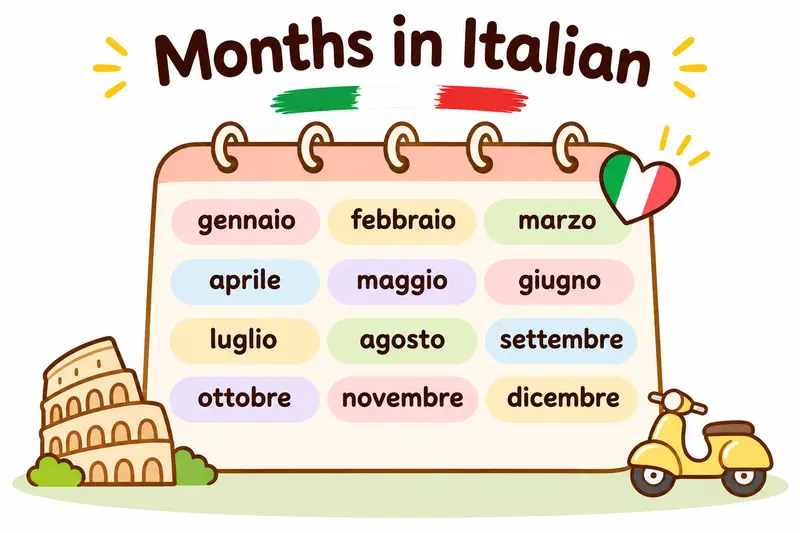
Learning the months in Italian is one of the easiest ways to start talking about dates, birthdays, holidays, and future plans.
The twelve Italian month names are similar to their English equivalents, so many will look familiar. However, their pronunciation, spelling, and grammatical usage are slightly different.
In this guide, you’ll learn all twelve months, listen to their pronunciation, and discover how Italians naturally use them in everyday conversations.
The 12 months in Italian
Here are all twelve months of the year in Italian:
| English | Italian |
|---|---|
| January | gennaio |
| February | febbraio |
| March | marzo |
| April | aprile |
| May | maggio |
| June | giugno |
| July | luglio |
| August | agosto |
| September | settembre |
| October | ottobre |
| November | novembre |
| December | dicembre |
Unlike English, Italian month names are normally written in lowercase, unless they appear at the beginning of a sentence.
For example:
- Gennaio è un mese freddo. — January is a cold month.
- Il mio compleanno è a gennaio. — My birthday is in January.
Let’s explore how to pronounce each month.
Table of Contents
Open Table of Contents
- How to pronounce the months in Italian
- Do you capitalize months in Italian?
- How to say “in January” or “in December” in Italian
- How to say dates in Italian
- How to ask and answer questions about dates
- Talking about birthdays in Italian
- Months and seasons in Italy
- Useful Italian expressions with months
- Everyday conversations using Italian months
- Common mistakes when using Italian months
- Practice exercises: Months in Italian
- How to memorize the Italian months
- Frequently asked questions
- Final thoughts
How to pronounce the months in Italian
Italian spelling is relatively consistent, but some month names contain sounds that English speakers may find unfamiliar.
Listen to each word and repeat it aloud.
1. Gennaio — January
Pronunciation: jen-NAH-yo
The Italian g before e produces a soft sound similar to the English j in January.
The stress falls on the second syllable.
2. Febbraio — February
Pronunciation: feb-BRAH-yo
Pay attention to the double b in febbraio.
Italian double consonants are pronounced longer than single consonants.
3. Marzo — March
Pronunciation: MAR-tso
The Italian z often represents a sound similar to ts or dz.
In marzo, the standard pronunciation uses a ts sound.
4. Aprile — April
Pronunciation: ah-PREE-leh
The stress falls on the second syllable.
5. Maggio — May
Pronunciation: MAH-joh
The combination ggi produces a soft j sound.
Remember that maggio contains a double g.
6. Giugno — June
Pronunciation: JOO-nyoh
The Italian gn represents a sound similar to the ny in canyon.
This sound also appears in words such as lasagna.
7. Luglio — July
Pronunciation: LOO-lyoh
The Italian gl before i produces a special sound, similar to a softened ly.
Listen carefully to the audio rather than pronouncing the letters separately.
8. Agosto — August
Pronunciation: ah-GOS-toh
The stress falls on the second syllable.
9. Settembre — September
Pronunciation: set-TEM-breh
Notice the double t.
10. Ottobre — October
Pronunciation: ot-TOH-breh
The double t should be pronounced clearly.
11. Novembre — November
Pronunciation: no-VEM-breh
The stress falls on the second syllable.
12. Dicembre — December
Pronunciation: dee-CHEM-breh
The Italian c before e produces a sound similar to ch in chair.
Do you capitalize months in Italian?
In English, month names are always capitalized.
In Italian, they are generally written in lowercase.
Correct:
- gennaio
- febbraio
- marzo
- aprile
Incorrect in ordinary sentences:
- Gennaio
- Febbraio
- Marzo
- Aprile
However, capitalization is appropriate at the beginning of a sentence or when required by a title.
For example:
Il corso inizia a settembre.
The course starts in September.
Settembre è il mio mese preferito.
September is my favorite month.
The same lowercase convention applies to the days of the week in Italian.
How to say “in January” or “in December” in Italian
When talking about events that happen during a particular month, Italian commonly uses the preposition a.
For example:
a gennaio — in January
a febbraio — in February
a marzo — in March
a dicembre — in December
Here are some natural sentences:
Vado in Italia a giugno.
I’m going to Italy in June.
Il mio compleanno è a settembre.
My birthday is in September.
La scuola inizia a settembre.
School starts in September.
A dicembre fa freddo.
It’s cold in December.
You may also encounter in before month names.
For example:
In agosto molti italiani vanno in vacanza.
In August, many Italians go on vacation.
Both constructions are possible, although a + month is a particularly useful pattern for beginners.
For a broader explanation of Italian prepositions, see our guide to prepositions in Italian.
How to say dates in Italian
Once you know the months, you can start expressing dates.
Italian dates usually follow this order:
day + month + year
For example:
15 marzo 2026
March 15, 2026
In spoken Italian, you commonly add the definite article before the day:
il 15 marzo
March 15
Here are some additional examples:
| Italian | English |
|---|---|
| il 5 gennaio | January 5 |
| il 12 febbraio | February 12 |
| il 20 aprile | April 20 |
| il 10 agosto | August 10 |
| il 25 dicembre | December 25 |
The first day of the month is different
Italian normally uses cardinal numbers for dates.
However, the first day of a month uses primo.
For example:
il primo gennaio
January 1
il primo maggio
May 1
il primo settembre
September 1
For other dates, use regular numbers:
il due gennaio
January 2
il tre maggio
May 3
il ventuno dicembre
December 21
To review Italian numbers, see our guide to Italian numbers from 1 to 100.
How to ask and answer questions about dates
Knowing the months allows you to ask useful questions.
Che giorno è oggi?
What day is it today?
Oggi è il 15 marzo.
Today is March 15.
In che mese siamo?
What month is it?
Siamo a novembre.
It’s November.
Quando è il tuo compleanno?
When is your birthday?
Il mio compleanno è il 12 luglio.
My birthday is July 12.
Quando vai in Italia?
When are you going to Italy?
Vado in Italia ad agosto.
I’m going to Italy in August.
Notice that a + agosto becomes ad agosto.
The form ad is commonly used before a word beginning with a.
If you want to learn how to form questions naturally, read our guide to Italian question words.
Talking about birthdays in Italian
Birthdays are one of the most common situations in which you’ll use month names.
The Italian word for birthday is compleanno.
Here are some useful expressions.
| Italian | English |
|---|---|
| Quando è il tuo compleanno? | When is your birthday? |
| Il mio compleanno è a maggio. | My birthday is in May. |
| Sono nato a febbraio. | I was born in February. (male speaker) |
| Sono nata a febbraio. | I was born in February. (female speaker) |
| Compio gli anni a ottobre. | My birthday is in October. |
You can also give a complete date:
Sono nato il 10 aprile 1995.
I was born on April 10, 1995.
Sono nata il 22 novembre 2000.
I was born on November 22, 2000.
The difference between nato and nata depends on the speaker’s grammatical gender.
Months and seasons in Italy
Knowing the Italian seasons makes it easier to describe weather, holidays, and travel plans.
Here are the four seasons:
| Italian | English |
|---|---|
| primavera | spring |
| estate | summer |
| autunno | autumn / fall |
| inverno | winter |
In Italy, the months are commonly grouped into meteorological seasons as follows:
| Season | Months |
|---|---|
| Primavera | marzo, aprile, maggio |
| Estate | giugno, luglio, agosto |
| Autunno | settembre, ottobre, novembre |
| Inverno | dicembre, gennaio, febbraio |
Here are some examples:
In primavera i fiori sbocciano.
Flowers bloom in spring.
In estate fa caldo.
It’s hot in summer.
In autunno le foglie cambiano colore.
Leaves change color in autumn.
In inverno fa freddo.
It’s cold in winter.
These seasonal groupings are useful for everyday conversation, although astronomical seasons begin on different dates.
Useful Italian expressions with months
Here are some additional expressions that will help you discuss schedules and plans.
Il mese prossimo — Next month
Parto il mese prossimo.
I’m leaving next month.
Il mese scorso — Last month
Sono stato a Roma il mese scorso.
I was in Rome last month.
Questo mese — This month
Questo mese lavoro molto.
I’m working a lot this month.
Ogni mese — Every month
Vado dal parrucchiere ogni mese.
I go to the hairdresser every month.
All’inizio del mese — At the beginning of the month
Pago l’affitto all’inizio del mese.
I pay the rent at the beginning of the month.
Alla fine del mese — At the end of the month
Partiamo alla fine del mese.
We’re leaving at the end of the month.
Da gennaio a marzo — From January to March
Il corso dura da gennaio a marzo.
The course lasts from January to March.
Entro dicembre — By December
Devo finire il progetto entro dicembre.
I have to finish the project by December.
These expressions are especially useful when arranging appointments, discussing deadlines, or making travel plans.
Everyday conversations using Italian months
Let’s see how month names appear in natural conversations.
Conversation 1: Planning a vacation
A: Quando vai in vacanza?
When are you going on vacation?
B: Vado in vacanza ad agosto.
I’m going on vacation in August.
A: Dove vai?
Where are you going?
B: Vado in Sicilia.
I’m going to Sicily.
Conversation 2: Talking about birthdays
A: Quando è il tuo compleanno?
When is your birthday?
B: È il 18 maggio.
It’s May 18.
A: Davvero? Il mio è a giugno!
Really? Mine is in June!
Conversation 3: Scheduling an appointment
A: Quando possiamo incontrarci?
When can we meet?
B: Possiamo incontrarci il 12 novembre.
We can meet on November 12.
A: Perfetto! A che ora?
Perfect! At what time?
B: Alle dieci del mattino.
At ten in the morning.
For more expressions about appointments and schedules, see our guide to telling time in Italian.
Common mistakes when using Italian months
Italian month names are relatively straightforward, but beginners often make a few predictable mistakes.
Mistake 1: Capitalizing every month
Incorrect: Il mio compleanno è a Marzo.
Correct: Il mio compleanno è a marzo.
Italian months are normally lowercase.
Mistake 2: Using English spelling
Incorrect: Vado in Italia a September.
Correct: Vado in Italia a settembre.
Even when the Italian word resembles English, its spelling may differ.
Mistake 3: Forgetting double consonants
Some Italian months contain double consonants:
- febbraio
- maggio
- settembre
- ottobre
Double consonants are important in Italian spelling and pronunciation.
Mistake 4: Saying “uno gennaio”
Incorrect: il uno gennaio
Correct: il primo gennaio
Use primo for the first day of the month.
Mistake 5: Using the wrong preposition
Incorrect: Vado in Italia a agosto.
Correct: Vado in Italia ad agosto.
The form ad agosto is natural because agosto begins with a.
Mistake 6: Translating English date order directly
English speakers may be accustomed to saying “March 15.”
In Italian, the standard order is:
il 15 marzo
March 15
Practice exercises: Months in Italian
Test your knowledge with these exercises.
Exercise 1: Translate into Italian
Translate the following months:
- January
- April
- July
- September
- December
Exercise 2: Complete the sentences
Fill in each blank with the correct Italian month.
- Christmas is in ______.
- Valentine’s Day is in ______.
- New Year’s Day is in ______.
- Halloween is in ______.
- International Workers’ Day is in ______.
Exercise 3: Choose the correct expression
1. How do you say “in March”?
A. a marzo
B. di marzo
C. il marzo
2. How do you say “January 1”?
A. il uno gennaio
B. il primo gennaio
C. il gennaio uno
3. Which sentence uses capitalization correctly?
A. Il mio compleanno è a Maggio.
B. Il mio compleanno è a maggio.
C. Il mio Compleanno è a Maggio.
4. How do you say “next month”?
A. il mese scorso
B. ogni mese
C. il mese prossimo
5. How do you say “in August”?
A. ad agosto
B. a agosto
C. il agosto
Answers
Exercise 1
- gennaio
- aprile
- luglio
- settembre
- dicembre
Exercise 2
- dicembre
- febbraio
- gennaio
- ottobre
- maggio
Exercise 3
- A — a marzo
- B — il primo gennaio
- B — Il mio compleanno è a maggio.
- C — il mese prossimo
- A — ad agosto
How to memorize the Italian months
Because Italian month names resemble English, you don’t need to memorize twelve completely unfamiliar words.
Instead, focus on their spelling and pronunciation.
Here is a simple five-minute routine.
Minute 1: Listen to all twelve months in order.
Minute 2: Repeat each month aloud.
Minute 3: Practice the months with unfamiliar sounds, especially gennaio, giugno, and luglio.
Minute 4: Say your birthday and the birthdays of two family members in Italian.
Minute 5: Practice a few complete sentences, such as:
Il mio compleanno è a maggio.
My birthday is in May.
Vado in vacanza ad agosto.
I’m going on vacation in August.
Il corso inizia a settembre.
The course starts in September.
Repeat this routine for several days until the month names feel natural.
Frequently asked questions
What are the 12 months in Italian?
The twelve months are gennaio, febbraio, marzo, aprile, maggio, giugno, luglio, agosto, settembre, ottobre, novembre, and dicembre.
Are Italian months capitalized?
No. Italian month names are normally written in lowercase, except at the beginning of a sentence or when capitalization is required by a title.
How do you say “month” in Italian?
The Italian word for month is mese.
The plural is mesi.
For example:
Un mese — One month
Due mesi — Two months
Dodici mesi — Twelve months
How do you say “next month” in Italian?
You can say il mese prossimo.
For example:
Ci vediamo il mese prossimo.
See you next month.
How do you say “last month” in Italian?
You can say il mese scorso.
For example:
Ho visitato Firenze il mese scorso.
I visited Florence last month.
How do you say “What month is it?” in Italian?
A natural expression is:
In che mese siamo?
You can answer:
Siamo a novembre.
It’s November.
How do you say “January 1” in Italian?
You say il primo gennaio.
Italian uses primo for the first day of a month and cardinal numbers for other dates.
Final thoughts
Learning the months in Italian gives you the vocabulary needed to discuss birthdays, travel plans, appointments, and important dates.
Start by memorizing the twelve month names, then practice combining them with common expressions such as a gennaio, il mese prossimo, and il primo maggio.
Once you’re comfortable with the months, review the days of the week in Italian to build a more complete understanding of how Italians talk about time and schedules.